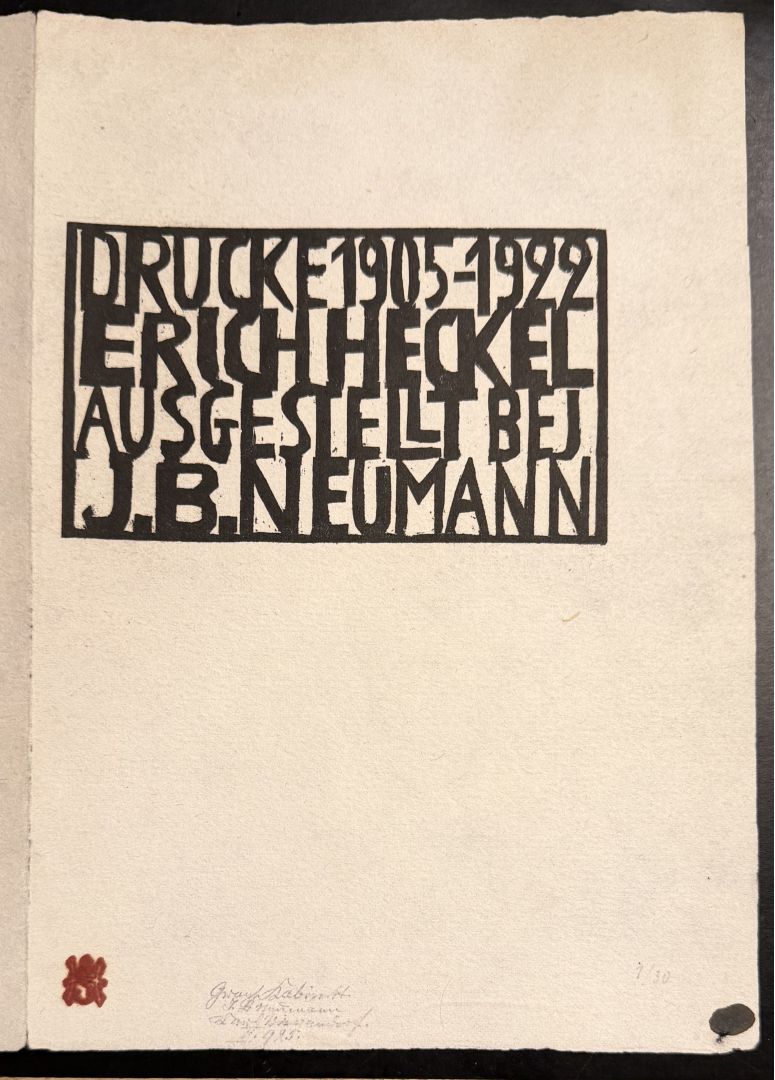
Heckel, Erich (German, 1883-1970). ERICH HECKEL: DRUCKE 1905-1922. J, B. Neumann, Berlin, 1923. The DeLuxe edition of 30, numbered 1/30 in pencil on the title page. Published in connection with an exhibition of Heckel's prints created between 1905 and 1922. Provenance: Ex Collection Heinrich Stinnes, with his collector's stamp (Lugt 1376a) on each page, and other annotations.A booklet comprising two folded sheets of thin handmade wove paper to make 8 pages, each 10 1/4 x 7 1/8 inches, each with an original woodcut by Heckel printed on its recto.Page 1: The exhibition title, Dube 331, in letters hand-cut by Heckel reading: "Drucke 1905-1922/Erich Heckel/Ausgestelt Bej/J.B. Neumann," unsigned. Inscribed "Grafik Kabinet/J B Neumann/ /1925." 3 1/4 x 5 inches. Page 2: Badende (Bathers), Dube 333, signed and dated "23" in pencil, and annotated in pencil near the lower left edge of the sheet "1/30 (1905-1922)." 4 1/2 x 2 3/4 inches.Page 3: Begegnung (Encounter), Dube 332, signed and dated "23" in pencil, and annotated in pencil near the lower left edge of the sheet "1/30 1905-1922." 4 5/8 x 2 3/4 inches.Page 4: Im Atelier (In the Studio), Dube 334, signed and dated "23" in pencil. 3 5/8 x 5 1/2 inches. There is a spot of black ink at the lower right corner of Page 1, possibly to obscure an early price, a small brown spot of staining at the right edge of page 4, near, but not affecting the image, a hint of browning at the top, and in the fold of the inner sheet (pages 2-3), yet overall an about Fine copy of a very scarce work. OCLC doesn't locate any copies.Erich Heckel (1883-1970) was a painter and printmaker. He was a founding member of Die Brucke (The Bridge), along with the other German Expressionists Kirchner, Schmidt-Rotluff, and Bleyl. Heckel continued as a painter and printmaker in the Expressionist mode after the dissolution of Die Brucke in 1913. In 1937, the Nazis named him as a "degenerate" artists. He was prohibited from painting, and much of his work, including his woodblocks and printing plates, was confiscated. After the war he continued to paint and to make prints. Israel Ber Neumann (1887-1961) was born in Ukraine, but moved to Germany where he worked for a dealer in books and art. In 1911 he opened his own book and art shop in Berlin, where he exhibited work by Edvard Munch, the members of Die Brucke, and others whose work was then considered "avant garde." In this respect he was somewhat like Vollard in Paris, serving as a dealer, publisher, and promoter of contemporary, non-traditional art. In 1922 he left Germany and moved to New York, where he opened a gallery on 57th Street where he exhibited work by Beckmann, Dix, Felixmuller, and other European artists, owrking to create a consciousness of Expressionist art in America. Heinrich Stinnes (1867-1932) was a wealthy collector who amassed a collection of some 200,000 prints and a library of 15,000 books focused on 19th and 20th Century European art. When he died the collection was sold at auction in Germany over a period of years. Given that these were the years of the Depression, and of Nazi control of Germany, it is likely that the sales achieved only a fraction of the value of the works. Stinnes was known to annotate works in his collection, and to impress them with his distinctive violet-colored monogram stamp. His younger brother Hugo, was one of the greatest industrialists in Germany during the Weimar Republic.